Natural & Forced Convection Experiment Bench
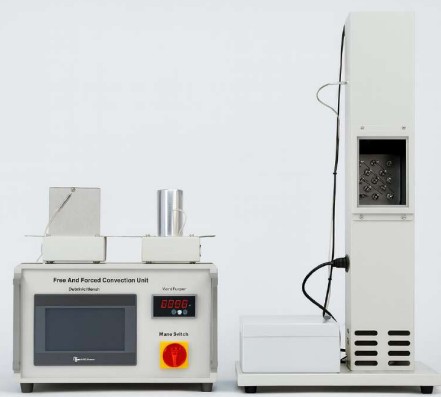
Natural & Forced Convection Experiment Bench
Product Overview
1.1 Overview
The ZT0006 Natural and Forced Convection Experiment Bench is designed to help students learn and understand convective heat transfer—one of the three fundamental modes of heat transfer in thermodynamics.
• Natural Convection: Occurs due to density differences in fluids caused by uneven temperature distribution.
• Forced Convection: Driven by external devices such as fans or pumps.
The ZT0006 provides a compact, plug-and-play teaching solution for both principles, featuring:
• A vertical pipe with detachable heating elements
• Multiple temperature sensors and anemometer
• Waterproof electrical junction box and power control box
• Interchangeable heat exchangers: tube bundle, cylindrical, and plate
This modular design allows students to conduct multiple experiments while observing and analyzing real-time data.
1.2 Key Features
1. Compact & User-Friendly – Small footprint, plug-and-play design for easy use in teaching labs.
2. Safe & Durable – Built with high-quality materials and protective coatings for long service life.
3. High Compatibility – Flexible software support and data communication options.
________________________________________
II. Performance Parameters
• Input Power: AC 220V / 50Hz
• Weight: 43 kg
• Dimensions: 485 × 370 × 915 mm; 440 × 430 × 350 mm
• Working Conditions:
o Ambient temperature: -10°C to +40°C
o Relative humidity: <85% (at 25°C)
________________________________________
III. Components & Configuration
3.1 Main Experimental Components
• Vertical Pipe – Core of the experiment
• Temperature Sensors (T1–T4) – Measure inlet, outlet, and surface temperatures
• Axial Fan – Drives forced airflow
• Anemometer – Measures air velocity
• Handheld Temperature Probe (T3) – For flexible local measurements
• Heat Exchangers (Tube Bundle, Cylindrical, Plate) – Interchangeable for different experiments
• Sight Glass Window – Visual observation of heating effects
• Waterproof Junction Box – Signal transmission
3.2 Power Box
• Display Screen – Shows parameters and controls components
• Power Meter – Displays heating element load
• Load Switch & Breaker – Safety control
• Aviation Sockets – For fan and sensor connections
• USB Interface – PC communication
3.3 Equipment Configuration List
• Tube Bundle Heat Exchanger × 1
• Cylindrical Heat Exchanger × 1
• Plate Heat Exchanger × 1
• Axial Fan × 1
• Temperature Sensors (incl. handheld) × 5
• Anemometer × 1
• Display Screen × 1
• Power Meter × 1
• Load Switch × 1
• Breaker × 1
3.4 Accessories
• Aviation Extension Cords × 2
• USB Cable × 1
• Pin-Shaped Plug Extension Cord × 1
• Three-Core British Power Cord × 1
• Fuse Tube (5A) × 5
• Software CD × 1
________________________________________
IV. Component Functions (Highlights)
• Heat Exchangers: AC220V input, measure surface heating efficiency
• Anemometer: Range 0–10 m/s for airflow analysis
• Temperature Sensors: Range 0–200°C for accurate monitoring
• Power Meter: Displays heating power load
• Display Screen: DC 24V input for parameter visualization and control
________________________________________
V. Experiment List
1. Natural vs. Forced Convection Demonstration
2. Convective Heat Transfer – Plate
3. Convective Heat Transfer – Single Tube
4. Convective Heat Transfer – Tube Bundle